Homeownership comes with significant ongoing costs, but the latest state and local tax deduction updates can unlock substantial savings for your renovation budget. The new salt deduction 2026 cap gives property owners a major financial cushion this tax season.
Navigating the newest 2026 tax law changes lets you keep more cash in your wallet for essential home improvements. Recent adjustments make itemizing deductions far more beneficial for middle-class and high-tax state homeowners.
Understanding these updated rules ensures you maximize every available dollar while upgrading your living space. Here is everything you need to know about navigating the current tax landscape smoothly.
Project Overview & Why It Matters
Managing your household finances requires the same precision and planning as framing a load-bearing wall or tiling a walk-in shower. For years, American homeowners faced tight constraints due to the rigid $10,000 cap on state and local taxes established under the 2017 Tax Cuts and Jobs Act (TCJA). That historic restriction limited how much property, state income, or sales tax you could write off against your federal taxable income. Today, the tax landscape offers vastly improved relief for property owners across the country.
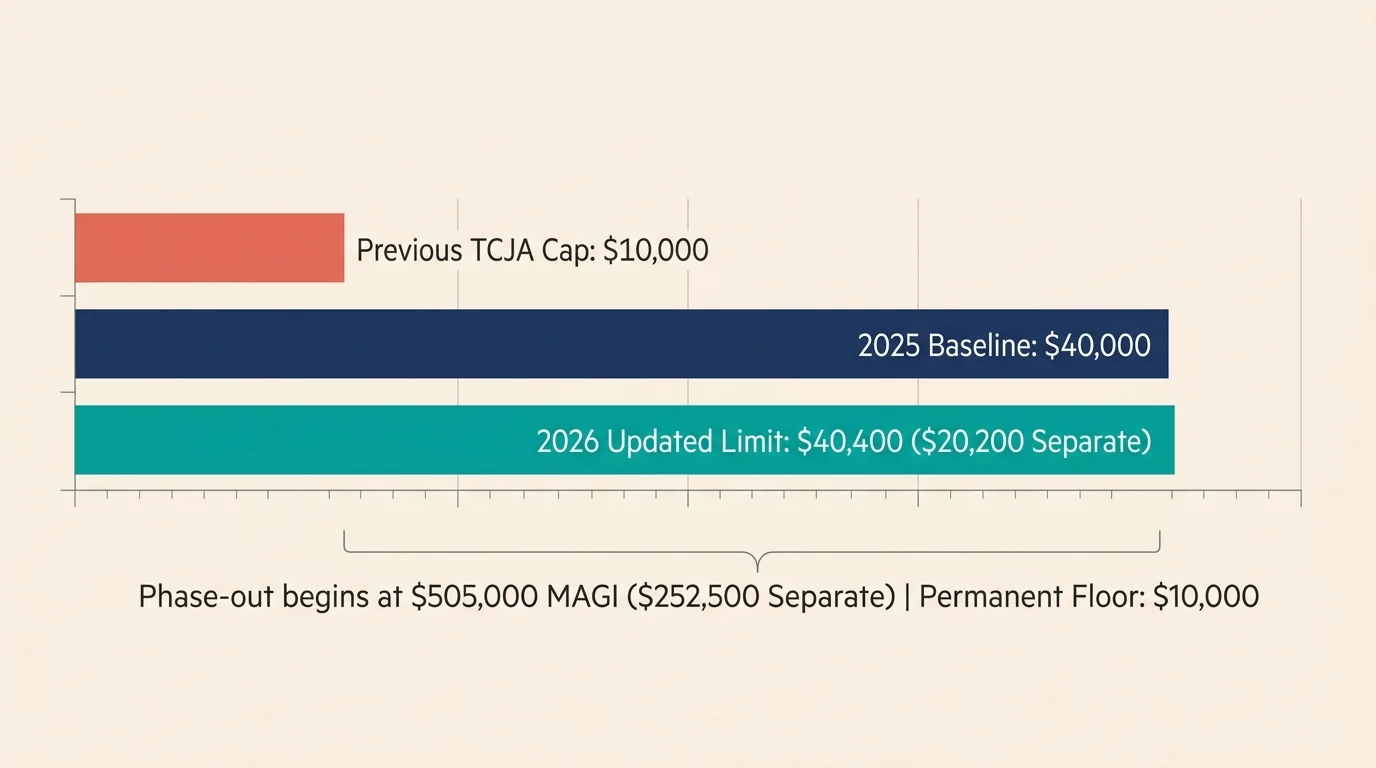
Under the revised guidelines, the deductible limit for the state and local tax deduction has climbed to $40,400 for single filers, heads of household, and married couples filing jointly. Married individuals filing separately can claim up to $20,200. This milestone represents a scheduled 1% inflation adjustment from the 2025 baseline limit of $40,000 ($20,200 for separate returns). By quadrupling the previous baseline, these salt cap changes allow millions of suburban and urban homeowners to dramatically lower their federal tax obligations.
High-earning households must account for specific phase-out thresholds under the current tax code. The full $40,400 deduction begins phasing out when your Modified Adjusted Gross Income (MAGI) reaches approximately $505,000 for joint filers or $252,500 for married individuals filing separately. Once your MAGI climbs past roughly $606,000, your deduction phases down to a permanent floor of $10,000 ($5,000 for separate filers). Even with these phase-outs, the overwhelming majority of homeowners will enjoy full access to the expanded deduction.
This financial relief matters directly to your home improvement ambitions. When you lower your annual tax bill by thousands of dollars, you create liquid capital for critical structural upgrades, modern design remodels, and energy-efficient retrofits. However, keep in mind that this expanded window is time-sensitive; under current legislation, the cap increases by 1% annually through 2029 before scheduled sunset provisions revert the cap to $10,000 in 2030 unless Congress passes extending legislation.